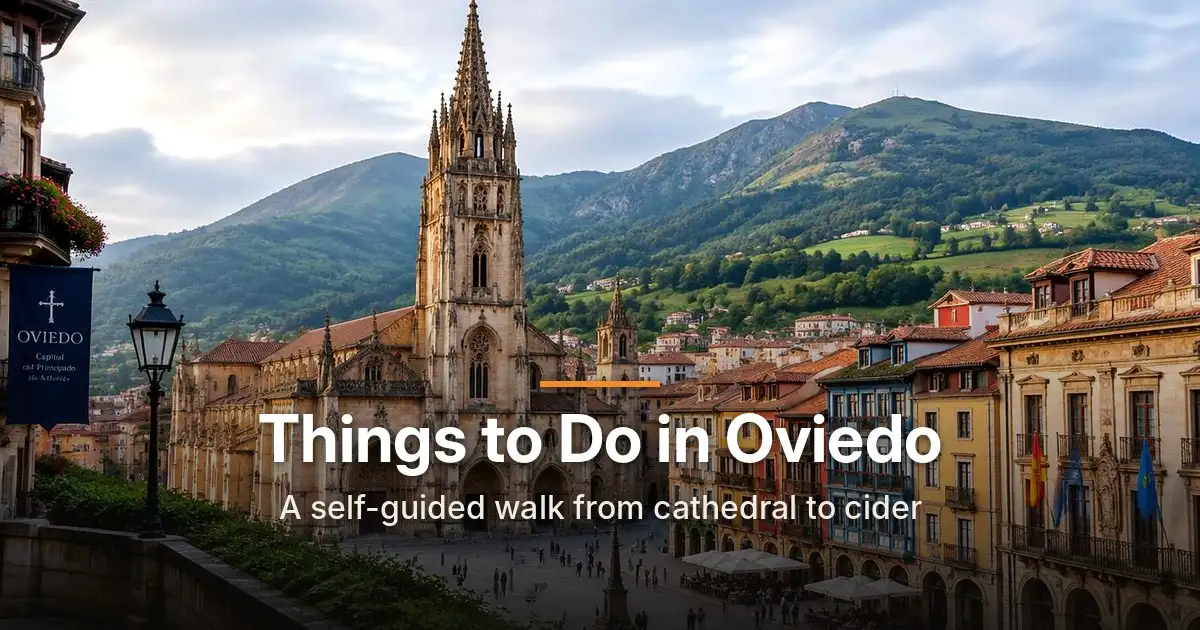
Oviedo, the capital of Asturias, is one of northern Spain's most rewarding small cities. In a single day you can see a Gothic cathedral, ninth-century churches on UNESCO's World Heritage List, a trail of quirky street sculptures and a whole street where cider is poured from above the waiter's head. The old town is compact and largely pedestrianised, which makes it ideal for exploring on foot at your own pace.
This guide covers the best things to do in Oviedo, in an order that works as a self-guided walking route, plus a short trip up Monte Naranco for the pre-Romanesque monuments.
Start at the Cathedral and Plaza de Alfonso II
Begin in Plaza de Alfonso II, in front of the Catedral de San Salvador. Its single Gothic tower is the city's landmark, and the square around it is lined with old stone palaces.
Inside, the highlight is the Cámara Santa (Holy Chamber), a chapel that dates back to the ninth-century Asturian kingdom. It keeps some of Spain's most important medieval treasures, including the Cross of the Angels and the Cross of Victory, which appears on the flag of Asturias. The Cámara Santa is part of the UNESCO site "Monuments of Oviedo and the Kingdom of the Asturias".
The cathedral is also the starting point of the Camino Primitivo, the oldest route of the Camino de Santiago, so you may well see pilgrims with backpacks setting off from the square.
Before you move on, look for the bronze statue of La Regenta, the heroine of Leopoldo Alas "Clarín"'s famous novel, which is set in a fictional city called Vetusta, modelled on Oviedo.
Wander the Old Town Squares
From the cathedral, the lanes of the old town lead to a string of squares that are perfect for a slow walk:
- Plaza de la Constitución, home to the city hall and the church of San Isidoro.
- Plaza de Trascorrales, a pretty square of painted houses that once held the city's fish market.
- Plaza del Fontán, an arcaded square with colourful balconies, next to the Fontán market hall, where locals shop for cheese, sausages and fresh produce.
This part of Oviedo is at its best in the late afternoon, when the café terraces fill up and the stone glows in the low light.
Hunt for Oviedo's Street Sculptures
Oviedo is famous for the sculptures scattered through its streets, and finding them is one of the most fun things to do in Oviedo. Some favourites:
- Woody Allen, a life-size bronze of the director, who received the Prince of Asturias Award for the Arts in 2002 and has spoken warmly about the city.
- Mafalda, the much-loved Argentine comic character, sitting on a bench in the Campo de San Francisco park.
- Culis Monumentalibus, a giant bronze pair of buttocks that has become one of the city's most photographed oddities.
Relax in the Campo de San Francisco
The Campo de San Francisco is Oviedo's green heart: a large park in the city centre with shady paths, fountains, ponds and resident peacocks. It's a lovely break between sights.
Nearby stands the Teatro Campoamor, the theatre where the Princess of Asturias Awards ceremony is held every October, one of the biggest cultural events in Spain.
Calle Gascona: Oviedo's Cider Boulevard
No visit is complete without a stop on Calle Gascona, known as the Bulevar de la Sidra. This short street is lined with sidrerías (cider houses) serving natural Asturian cider.
Watch the waiters pour it in the traditional way, called escanciar: the bottle held high above the head and the glass low by the hip, so the cider splashes and gets aerated. You're served a small amount, a culín, which you drink in one go while it's still lively.
Pair it with Asturian classics:
- Fabada asturiana, a rich stew of white beans with chorizo, black pudding and pork.
- Cachopo, two large veal fillets filled with ham and cheese, breaded and fried. It's made for sharing.
- Asturian cheeses, such as the strong blue Cabrales.
Something Sweet: Carbayones and Moscovitas
Oviedo has its own pastries. The carbayón is a puff pastry filled with an almond cream and glazed with sugar, named after the old oak tree that gave the people of Oviedo their nickname, carbayones. Moscovitas are thin, crunchy almond and chocolate biscuits that make a good edible souvenir.
Monte Naranco: The Pre-Romanesque Churches
Just above the city, on the slopes of Monte Naranco, stand two of the most remarkable buildings in Spain. Both date from the ninth century and belong to the same UNESCO World Heritage site as the Cámara Santa.
- Santa María del Naranco was built as a palace for King Ramiro I and later became a church. Its arcaded balconies and slender proportions are unlike anything else from the period.
- San Miguel de Lillo, a short walk further up, is a church famous for its carved stone details.
You can reach them by taxi or bus, or on a steady uphill walk from the centre. The hillside also gives you a wide view over Oviedo and the green Asturian countryside.
Back in the city, don't miss San Julián de los Prados (also called Santullano), another pre-Romanesque church of the same UNESCO site, known for its painted interior.
Tips for Visiting Oviedo
- Pack a light rain jacket. Asturias is green for a reason, and showers are common at any time of year.
- Plan one full day, or a day and a half if you want an unhurried visit to Monte Naranco.
- Eat late, Spanish style. The cider houses get busy at lunch and from about 9 pm.
- Wear comfortable shoes. The old town is paved in stone and the walk up Naranco is steep in places.
Explore Oviedo with Tour Me On
The easiest way to see all of this without a guidebook in your hand is with Tour Me On, the self-guided audio tour app for Spanish cities. The Oviedo tour has 69 stops, narrated in English and Spanish, so you can walk at your own pace and hear the story behind every square, statue and church as you reach it.
You can listen to a free preview of every stop before you buy, and the full Oviedo guide is a one-time purchase in the app. Tour Me On also covers 28 more Spanish cities, from Madrid and Barcelona to Santiago de Compostela and San Sebastián.
Download Tour Me On on the App Store or Google Play and start your self-guided walk through Oviedo today.