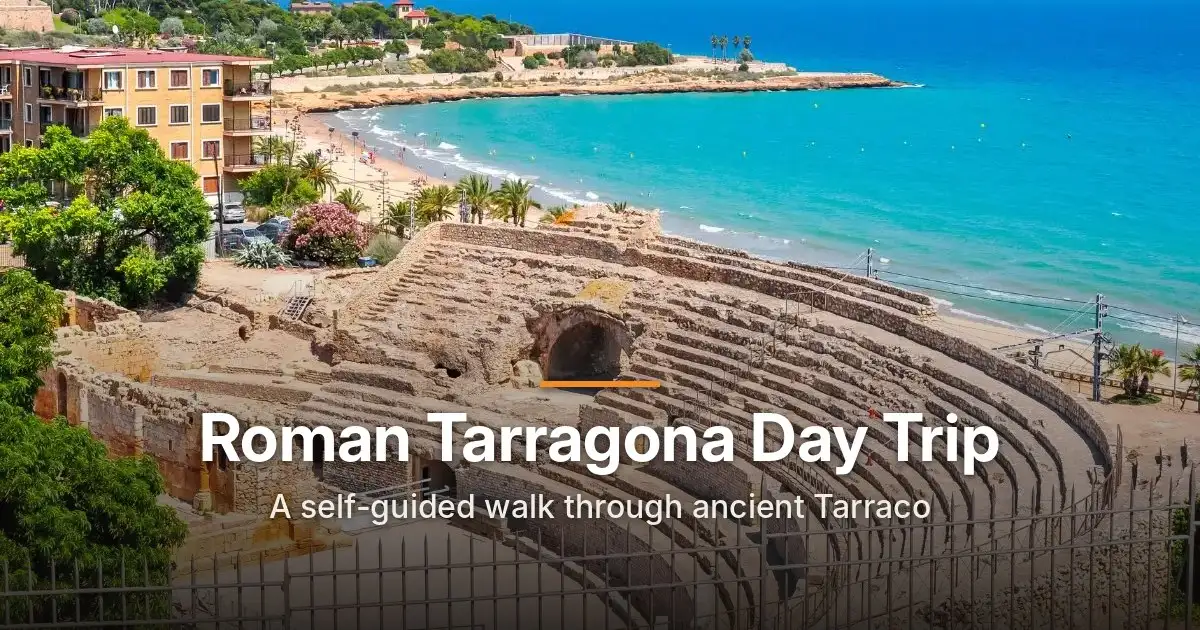
Most people heading south from Barcelona are on their way somewhere else. Those who stop in Tarragona find one of the richest Roman cities in Spain, packed into a walkable old town above the sea. An amphitheatre facing the Mediterranean, the vaults of a chariot-racing circus hidden under medieval streets, and walls older than almost anything else Rome built outside Italy: Roman Tarragona is an easy, rewarding day trip from Barcelona, and a quiet one in the cooler months.
This guide sets out a self-guided route through the old city, with what to look for at each stop and a few tips for planning your day.
Why Tarragona was so important to Rome
Tarragona began as a Roman military camp in 218 BC, during the Second Punic War, when the Scipio brothers landed here to fight Carthage. The settlement, called Tarraco, grew into one of the main cities of Roman Hispania and the capital of the vast province of Hispania Tarraconensis. Emperor Augustus spent time here during his campaigns in the north of the peninsula.
That status left a remarkable architectural legacy. In 2000, UNESCO listed the Archaeological Ensemble of Tarraco as a World Heritage Site, recognising how much of the Roman city survives. Much of it is not fenced off in a single archaeological park; it is woven into the fabric of the modern town, which is what makes walking it so enjoyable.
Getting there: Tarragona as a day trip from Barcelona
Tarragona sits on the coast south-west of Barcelona. Regional trains run along the shoreline to Tarragona's central station, which is a short walk from the old town, and the ride takes roughly an hour. High-speed trains also stop at Camp de Tarragona, a station outside the city, so check which one your ticket uses. Leaving Barcelona in the morning gives you a full day to walk the Roman sites and still be back for dinner.
A self-guided route through Roman Tarragona
The route below runs roughly from the sea up to the highest part of the old town, then back down. Allow a full day if you want to go inside the monuments, or half a day for a walk focused on the outside.
1. The Roman amphitheatre by the sea
Start where most visitors' jaws drop: the Tarragona amphitheatre, built in the 2nd century AD on a slope right above the beach. Gladiator fights and public spectacles were held here, with the sea as a backdrop. The site has a later layer of history too. In AD 259 the bishop Fructuosus and his deacons Augurius and Eulogius were martyred in the arena, and centuries later a Visigothic basilica and then a Romanesque church were built on the spot where they died. You can still see the outline of that church in the middle of the arena.
2. Balcó del Mediterrani
A short climb takes you to the Balcó del Mediterrani, the viewpoint at the top of the Rambla Nova. From the railing you get a wide view over the amphitheatre, the coastline and the port. Locals have a habit of touching the iron railing for good luck, known as "tocar ferro". It is a free viewpoint and one of the best spots in the city for photos, especially in the late afternoon.
3. The Roman circus and the Praetorium
Tarraco had a circus for chariot races, built in the late 1st century AD between the lower town and the upper terraces. When the medieval town grew, houses were built on top of it, so today its long vaulted passages survive beneath the streets of the Part Alta. Plaça de la Font, the square in front of the city hall, follows the line of the old racetrack. Next to the circus rises the Praetorium, a Roman tower that was later turned into a medieval palace. Climb to the top for one of the best views over the old town and the sea.
4. The provincial forum and the cathedral
At the top of the hill was the provincial forum, the political and religious heart of the province, laid out on great terraces. Tarragona Cathedral, a mix of Romanesque and Gothic, is believed to stand on the site of the temple dedicated to Augustus. Walk around the cathedral and the narrow lanes nearby and you will spot Roman stones reused in medieval walls, a reminder that the town was built from, and on top of, Tarraco.
5. The Roman walls and the Passeig Arqueològic
End the upper-town loop on the Passeig Arqueològic, a garden walk that follows the outside of the Roman walls. Parts of these walls date back to the 3rd and 2nd centuries BC, and they are considered among the oldest Roman structures preserved outside Italy. Look for the huge, roughly shaped lower blocks, laid before the neater Roman masonry above them, and for the Tower of Minerva with its carved relief.
6. The local forum in the lower town
Walk down through the modern centre to the remains of the colonial forum, the forum used by the city's own residents. Columns and foundations of public buildings stand among today's apartment blocks, which makes for a striking contrast and a good final stop before lunch.
Beyond the old town
Pont del Diable aqueduct
A few kilometres north of the centre stands the Pont del Diable, or Devil's Bridge, a two-tier Roman aqueduct that once carried water to Tarraco. It is a short trip by bus or car and well worth it if you have time left in the afternoon.
El Serrallo and local food
The fishing quarter of El Serrallo, next to the port, is the place to go for seafood. Tarragona's province is also home to romesco, the nut-and-pepper sauce served with fish and grilled vegetables. If you visit in late winter, look out for calçots, the grilled spring onions dipped in romesco that are a seasonal tradition in this part of Catalonia.
Tips for visiting Tarragona
- Wear good shoes. The old town is hilly and many streets are cobbled.
- Go in the cooler months. Late autumn and winter bring mild weather and fewer visitors, ideal for walking between sites.
- Check opening times before you go. The Roman monuments are managed by the city and have their own schedules, which can change by season.
- Look for the castells. Tarragona is a heartland of castells, the Catalan human towers recognised by UNESCO as Intangible Cultural Heritage. If you are in town during a festival, you may catch a display.
Explore Roman Tarragona with Tour Me On
Roman ruins come alive when you know the stories behind the stones. Tour Me On's Tarragona guide has 20 audio stops you can follow at your own pace, in English or Spanish, with most stories lasting about 3 to 7 minutes. Download the guide before you leave Barcelona and it works offline, with no Wi-Fi or mobile data needed.
To visit the Roman sites in order, follow the Roman Tarraco walking tour: 9 audio stops from the amphitheatre and the circus to the forums, the walls and the Pont del Diable.
Tour Me On is free to download, every stop has a free audio preview, and your first 3 full stories are free. Unlocking a city is a one-time purchase, with no subscription.
Download Tour Me On on the App Store or Google Play and start your walk through ancient Tarraco.