Tarragona
20 points of interest
Anfiteatro (Amphitheatre) (must see)
Must seeAttraction/Landmark
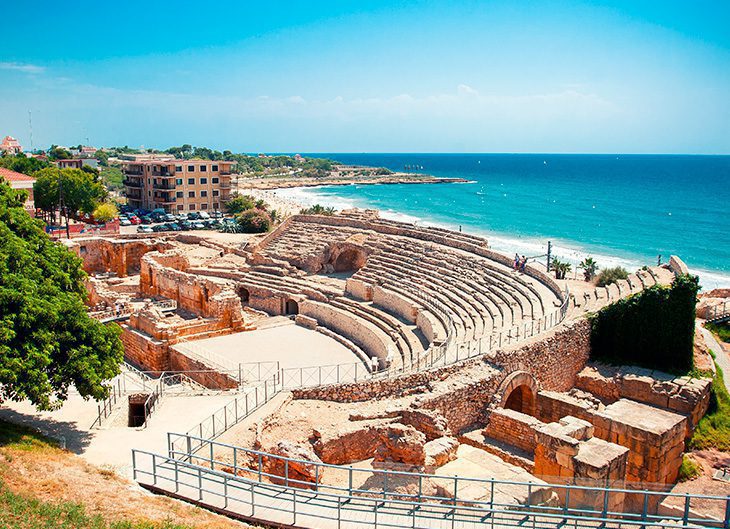
A magnificent 2nd-century Roman amphitheatre carved into the hillside overlooking the Mediterranean Sea, where gladiatorial combats and public spectacles once entertained up to 15,000 spectators, and which later housed a Visigothic basilica and a medieval church within its arena.
Balcó del Mediterrani (Mediterranean Balcony) (must see)
Must seeAttraction/Landmark
A stunning panoramic viewpoint at the end of the Rambla Nova offering sweeping views over the Mediterranean Sea, the beach, and the Roman amphitheatre below, where the local tradition of 'tocar ferro' — touching the iron railing for good luck — has been practiced for generations.
Catedral Basilica Metropolitana Primada de Tarragona (Metropolitan Primatial Basilica Cathedral of Tarragona) (must see)
Must seeReligious
Tarragona's crowning jewel, this 12th-century cathedral masterfully blends Romanesque and Gothic styles with a magnificent unfinished facade, a serene cloister adorned with carved capitals, and a stunning rose window, all built on the site of a Roman temple and later a Moorish mosque.
Pont del Diable (Devil's Bridge) (must see)
Must seeAttraction/Landmark
A superbly preserved 1st-century Roman aqueduct standing 27 meters high and stretching over 200 meters across a verdant valley, the Pont del Diable is a UNESCO World Heritage Site and an engineering marvel that once carried water from the Francolí River to the ancient city of Tarraco.
Ca La Garsa (The Garsa House)
Attraction/Landmark
A beautifully restored medieval townhouse in the heart of Tarragona's old quarter that reveals layers of the city's history, with Roman foundations visible beneath Gothic arches and Renaissance details, now serving as a cultural space and restaurant.
Casa Castellarnau (Castellarnau House)
Museum/Gallery
An elegant 15th-century noble residence that blends Gothic and Baroque architecture, Casa Castellarnau houses a museum showcasing period furnishings, decorative arts, and archaeological finds, built atop Roman structures that remain visible in the basement.
Circ Roma (Roman circus)
Attraction/Landmark
The remains of a 1st-century Roman circus that once hosted thrilling chariot races for up to 30,000 spectators, stretching over 300 meters through what is now the old town, with remarkably preserved vaulted galleries and tunnels still visible beneath modern buildings.
El Foro de la Colonia (The Forum of the Colony)
Attraction/Landmark
The excavated ruins of the civic heart of Roman Tarraco, where citizens gathered for commerce, politics, and justice, featuring the remains of a basilica, market stalls, and a temple, offering a vivid glimpse into daily life in one of Rome's most important provincial capitals.
El Serrallo (The Serrallo)
Attraction/Landmark
Tarragona's charming old fishing quarter nestled around the harbour, El Serrallo is famous for its row of excellent seafood restaurants, its colorful fishing boats, and the daily fish auction at the Llotja, preserving the authentic maritime character of the city.
Forum Provincial Tarraco (Tarragona Provincial Square)
Attraction/Landmark
The monumental remains of the Provincial Forum of Tarraco, once the administrative and religious center of the entire Roman province of Hispania Citerior, featuring massive terraced construction, towering walls, and fragments of the temple dedicated to Emperor Augustus.
La Rambla Nova (The New Boulevard)
Attraction/Landmark
Tarragona's elegant main promenade, the Rambla Nova is a tree-lined boulevard stretching from the city center to the Mediterranean Balcony, flanked by modernist buildings, outdoor cafes, and notable monuments including the Centenary Fountain and the Monument to the Heroes of 1811.
Maqueta Tarraco (Tarragona Maquette)
Attraction/Landmark
A detailed scale model of Roman Tarraco at its peak, this fascinating maquette brings the ancient city to life by showing the amphitheatre, circus, forums, temples, and port as they appeared two thousand years ago, helping visitors visualize the grandeur of the imperial capital.
Mercado Central (Central Market)
Shopping
A lively modernist market hall built in the early 20th century, the Mercado Central is where locals shop for fresh fish, meats, fruits, vegetables, and regional delicacies, offering visitors an authentic taste of Tarragona's culinary traditions beneath its striking iron and glass structure.
Monumento als Castellers (Monument to the Castellers)
Monument
A striking bronze sculpture celebrating the deeply rooted Catalan tradition of human tower building, depicting castellers forming their iconic structure, honoring Tarragona's status as the world capital of castells and the biennial Concurs de Castells competition held in the city.
Muralles Romanes de Tarragona (Roman Walls of Tarragona)
Attraction/Landmark
Among the oldest Roman fortifications outside Italy, Tarragona's imposing city walls date back to the 3rd century BC and stretch over one kilometer, featuring massive megalithic stone blocks, medieval towers, and gates that have guarded the city for over two millennia.
Museu Nacional Arqueologic de Tarragona (National Archaeological Museum of Tarragona)
Museum/Gallery
The oldest archaeological museum in Catalonia, housing an extraordinary collection of Roman mosaics, sculptures, ceramics, and everyday objects from ancient Tarraco, providing an essential introduction to understanding the city's UNESCO World Heritage archaeological ensemble.
Placa de la Font (Fountain Square)
Attraction/Landmark
The vibrant main square of Tarragona's old town, built directly over the arena of the ancient Roman circus, Plaça de la Font is surrounded by colorful 19th-century facades, lively terraces, and the neoclassical City Hall, serving as the social heart of the city.
Placa dels Sedassos Mural (The Silk Square Mural)
Monument
A captivating trompe-l'oeil mural painted on the facade of a building in the old quarter, depicting lifelike figures of Tarragona's traditional festivals including castellers, gegants, and the Santa Tecla celebrations, blurring the line between art and reality in a charming small square.
Torre de les Monjes (Tower of the Monks)
Attraction/Landmark
A medieval watchtower perched on the cliffside near the amphitheatre, the Torre de les Monges once formed part of the city's defensive network and takes its name from the nearby convent, offering dramatic views over the coastline and the ancient amphitheatre below.
Torre del Pretorio Romana (Roman Praetorium Tower)
Attraction/Landmark
A commanding Roman tower from the 1st century BC that served as a corner of the Provincial Forum complex, the Praetorium Tower features underground passageways connecting it to the circus and offers panoramic rooftop views over the city, the sea, and the surrounding Roman monuments.