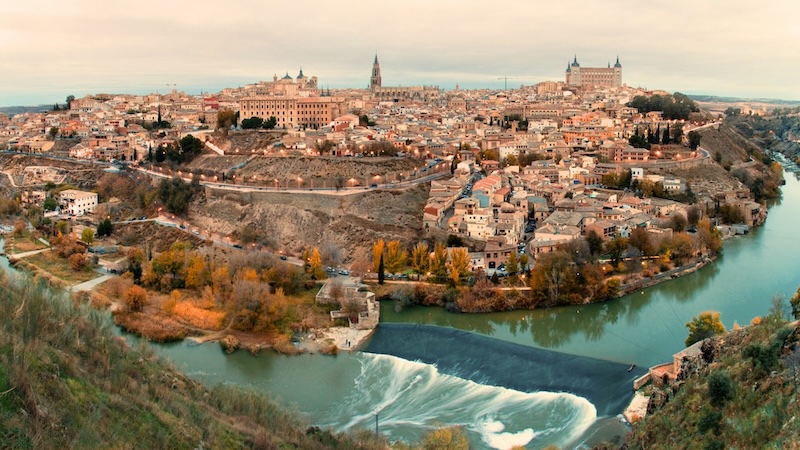
Toledo
45 points of interest
Alcazar Fortress
Must seeAttraction/Landmark
Towering over Toledo's highest point, this imposing fortress has served as a Roman palace, Visigothic seat, and medieval castle, and now houses Spain's Army Museum with centuries of military history.
Iglesia de Santo Tome (Church of Saint Thomas)
Must seeReligious
Home to El Greco's masterpiece 'The Burial of the Count of Orgaz,' this 14th-century church with its elegant Mudéjar tower is one of Toledo's most visited landmarks and an essential stop for art lovers.
Mirador del Valle (Valley Lookout)
Must seeAttraction/Landmark
The ultimate panoramic viewpoint of Toledo, offering a breathtaking vista of the entire walled city perched above the Tagus River -- the same view that inspired El Greco's iconic cityscape painting.
Monasterio de San Juan de los Reyes (Monastery of Saint John of the Monarchs)
Must seeReligious
Commissioned by Ferdinand and Isabella to celebrate their victory at the Battle of Toro, this stunning Isabelline Gothic monastery features an exquisite cloister and chains of freed Christian prisoners hanging on its outer walls.
Museo del Greco (El Greco Museum)
Must seeMuseum/Gallery
Dedicated to the Greek-born painter who made Toledo his home, this museum recreates a period dwelling and displays key works including his famous series of the Twelve Apostles and a panoramic view of Toledo.
Toledo Cathedral and Monstrance of Arfe
Must seeReligious
Spain's primate cathedral, a 13th-century Gothic masterpiece filled with works by El Greco, Goya, and Caravaggio, and home to the spectacular 16th-century gold and silver Monstrance of Arfe, paraded through Toledo during Corpus Christi.
Agustinas Ermitanas Convento Santa Ursula (Convent of St. Ursula)
Religious
A serene 14th-century convent still home to an enclosed order of Augustinian nuns, known for its Gothic cloister and the handmade marzipan the sisters sell through a revolving window.
Arco de la Sangre (Blood Arch)
Attraction/Landmark
This medieval archway at the entrance of Zocodover Square takes its ominous name from the blood shed during centuries of public executions and Inquisition acts that once took place nearby.
Ayuntamiento de Toledo (Toledo City Hall)
Attraction/Landmark
Toledo's elegant 17th-century City Hall features a striking Herreresque facade with twin towers and overlooks the Plaza del Ayuntamiento, flanked by the Cathedral and the Archbishop's Palace.
Castillo de San Servando (Castle of San Servando)
Attraction/Landmark
Originally built as a Visigothic monastery and later fortified by the Moors, this 14th-century castle guards the eastern approach to Toledo across the Tagus River with its distinctive square towers.
Church of St. Roman and Museum of Councils and Visigothic Culture
Religious
This 13th-century Mudéjar church boasts stunning Romanesque frescoes and horseshoe arches, and now serves as a museum showcasing Toledo's pivotal role as the Visigothic capital of Hispania.
Convento de San Antonio de Padua (St. Anthony of Padua Convent)
Religious
A peaceful Franciscan convent founded in the 15th century, where cloistered nuns still live in contemplative life and sell traditional sweets and pastries through a wooden turnstile.
Convento de San Pedro Martir (St Peter Martyr Convent)
Attraction/Landmark
A grand 16th-century Dominican convent with a Renaissance cloister, now part of the University of Castilla-La Mancha and home to occasional art exhibitions and cultural events.
Convento de los Carmelitas Descalzos (Convent of the Discalced Carmelites)
Religious
Founded in the spirit of St. Teresa of Avila's reform, this Carmelite convent sits near the old city walls and reflects the austere spirituality of the Discalced order that shaped Spanish mysticism.
Cuevas de Hercules (Cave of Hercules)
Attraction/Landmark
Mysterious underground vaults beneath Toledo's streets, steeped in legend claiming Hercules himself built them. These Roman-era cisterns reveal the hidden subterranean world beneath the city.
El Pozo De Los Deseos R. Saavedra (The Wishing Well)
Attraction/Landmark
A charming medieval well tucked into Toledo's winding streets where visitors toss coins and make wishes, carrying on a tradition that locals say dates back centuries.
Ermita 'Mezquita' del Cristo de la Luz (Mosque of Cristo de la Luz)
Religious
Toledo's oldest surviving monument, this tiny 10th-century mosque with nine distinct ribbed vaults was later converted into a Christian chapel, perfectly embodying the city's layered cultural heritage.
Ermita del Cristo de la Vega (Hermitage of Cristo de la Vega)
Attraction/Landmark
A humble Mudéjar hermitage built on the ruins of an ancient Visigothic basilica, famous for the legend of the Christ figure that lowered its hand to serve as witness in a broken promise trial.
Estacion de Toledo (Toledo Railway Station)
Attraction/Landmark
One of Spain's most beautiful train stations, this 1919 Neo-Mudéjar gem features ornate horseshoe arches, colorful ceramic tiles, and a clock tower that makes arriving in Toledo unforgettable.
Hospital de Tavera (Tavera Hospital)
Attraction/Landmark
A magnificent Renaissance palace-hospital commissioned by Cardinal Tavera in the 16th century, housing an impressive art collection with works by El Greco, Tintoretto, and Ribera in its grand dual-courtyard complex.
Iglesia de El Salvador (Church of El Salvador)
Religious
Built atop a former mosque, this church preserves a Visigothic column and Islamic-era architectural remains in its foundations, offering a fascinating archaeological window into Toledo's layered past.
Iglesia de San Andres (Church of St. Andrew)
Religious
One of Toledo's oldest parish churches with origins in the 12th century, blending Mudéjar and Gothic styles while housing a beautiful retable and serene atmosphere away from the main tourist routes.
Iglesia de San Ildefonso (Church of San Ildefonso)
Museum/Gallery
This Baroque Jesuit church offers one of the best panoramic views of Toledo from its twin bell towers, and its dazzling white interior contrasts beautifully with the city's medieval atmosphere.
Iglesia de Santiago del Arrabal (Church of Santiago)
Religious
Considered the finest example of Mudéjar architecture in Toledo, this 13th-century church near the Bisagra Gate features a stunning triple-apsed exterior and ornate brickwork typical of the style.
Iluziona Museum
Museum/Gallery
A family-friendly museum of optical illusions and interactive exhibits that offers a playful break from Toledo's historical sites, with mind-bending rooms and photo-worthy installations.
Juderia de Toledo (Jewish Quarter)
Attraction/Landmark
Once home to one of medieval Spain's largest and most prosperous Jewish communities, this atmospheric quarter of narrow cobblestone lanes preserves two ancient synagogues and echoes of Sephardic heritage.
Mezquita de Las Tornerias (Mosque of las Tornerias)
Religious
A hidden 11th-century mosque tucked above a commercial street, this intimate prayer space with its nine columns and cross vaults reveals how Islamic worship coexisted within the medieval Christian city.
Monasterio de Santo Domingo el Antiguo (Monastery of Saint Dominic the Old)
Religious
Toledo's oldest convent, where El Greco received his first major commission in Spain. The painter's remains are believed to rest here, and the church still displays original altarpiece paintings by him.
Muralla de Toledo (City Walls of Toledo)
Attraction/Landmark
Toledo's ancient city walls, built and rebuilt by Romans, Visigoths, and Moors over more than a millennium, encircle the old town and feature monumental gates that once controlled access to this strategic hilltop city.
Museo Victorio Macho (Victorio Macho Museum)
Museum/Gallery
Perched on a cliff overlooking the Tagus River, this museum showcases the powerful sculptures and drawings of Victorio Macho, one of Spain's most important 20th-century sculptors, in his former home and studio.
Museo de Santa Cruz (Santa Cruz Museum)
Museum/Gallery
Housed in a stunning 16th-century hospital designed by Enrique Egas, this free museum features an outstanding collection of El Greco paintings, medieval artifacts, and decorative arts beneath soaring Renaissance ceilings.
Museo del Queso Manchego (Manchego Cheese Museum)
Museum/Gallery
A delightful museum celebrating La Mancha's most famous culinary export, where visitors learn about traditional Manchego cheese-making from sheep's milk and enjoy tastings of this iconic Spanish cheese.
Palacio de Galiana (Galiana Palace)
Attraction/Landmark
A romantic 11th-century Moorish palace set in gardens along the Tagus River, linked to the legend of Princess Galiana and King Alfonso VI, blending Islamic architecture with centuries of Toledan lore.
Plaza de Zocodover (Zocodover Square)
Attraction/Landmark
Toledo's vibrant main square, whose name derives from the Arabic 'suq ad-dawabb' (livestock market), has been the city's social heart since medieval times and remains the perfect starting point for exploring the old town.
Puente de Alcantara (Alcantara Bridge)
Attraction/Landmark
A Roman-founded bridge rebuilt by the Moors and later fortified with a Baroque arch, spanning the Tagus River at Toledo's eastern entrance with dramatic views of the Alcazar above.
Puente de San Martin (San Martin Bridge)
Attraction/Landmark
A magnificent 14th-century Gothic bridge with five arches spanning the Tagus River on Toledo's western side, guarded by fortified towers and offering stunning sunset views of the city and river gorge.
Puerta Bab al-Mardum (Blocked Gate)
Attraction/Landmark
An ancient Moorish gate in Toledo's northern walls, named 'Bab al-Mardum' in Arabic, that stands beside the Cristo de la Luz mosque and marks one of the original entrances to the Islamic city.
Puerta de Alcántara (Alcantara Gate)
Attraction/Landmark
A fortified medieval gate at the eastern end of the Alcantara Bridge, this imposing double-arched entrance controlled access to the city from the river crossing and still bears the scars of centuries of conflict.
Puerta de Alfonso VI (Alfonso VI Gate)
Attraction/Landmark
Also known as the Puerta Vieja de Bisagra, this 10th-century Moorish gate is where King Alfonso VI triumphantly entered Toledo in 1085 during the Christian Reconquest, making it one of the city's most historically significant landmarks.
Puerta de Bisagra Nueva (New Hinged Door)
Attraction/Landmark
Toledo's most iconic gateway, this monumental 16th-century Renaissance gate features a massive imperial coat of arms of Charles V and twin semicircular towers that majestically welcome visitors to the city.
Puerta del Cambron (Cambron Gate)
Attraction/Landmark
Named after the thorny brambles that once grew nearby, this western gate dates from Visigothic times and was rebuilt in the Renaissance, featuring a statue of Toledo's patron saint, Santa Leocadia.
Puerta del Sol (Sun Gate)
Attraction/Landmark
A striking 14th-century Mudéjar gate crowned with a sun medallion and horseshoe arches, built by the Knights Hospitaller as part of the city's northern defensive walls.
Sinagoga de Santa Maria La Blanca (Synagogue of Saint Mary the White)
Religious
Europe's oldest surviving synagogue building, this 12th-century masterpiece features 28 white horseshoe arches and ornate plasterwork crafted by Moorish artisans, symbolizing Toledo's famous three-culture coexistence.
Synagogue of El Transito and Sephardic Museum
Religious
Built in 1357 by Samuel ha-Levi, treasurer to King Pedro I, this synagogue stuns with its intricate Mudéjar stucco work and now houses Spain's Sephardic Museum, preserving the rich heritage of Iberian Jews.
The Disrobing of Christ Painting at Toledo Cathedral
Attraction/Landmark
El Greco's dramatic 'El Expolio' (1577-1579), housed in the Cathedral sacristy, is one of his earliest and most powerful works in Spain, depicting Christ's vivid red robe moments before the Crucifixion.