Segovia
31 points of interest
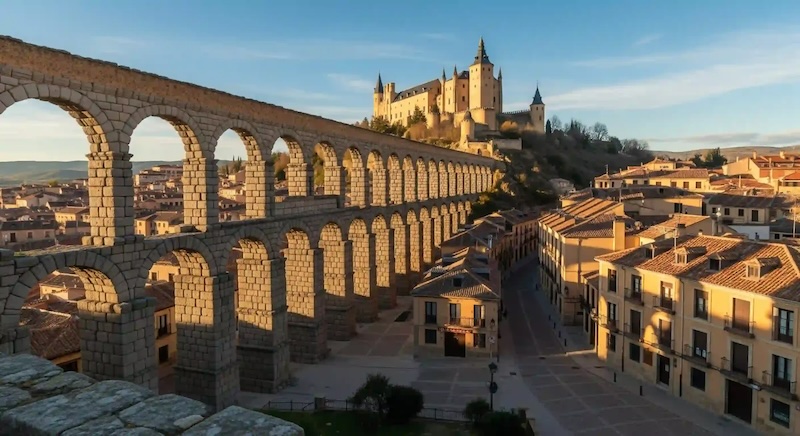
Alcázar of Segovia (Segovia Castle)
Must seeAttraction/Landmark
A fairy-tale castle perched on a rocky crag that inspired Walt Disney, this 12th-century fortress served as a royal palace, state prison, and military academy throughout Spanish history.
Aqueduct of Segovia
Must seeAttraction/Landmark
One of the best-preserved Roman engineering marvels in the world, this 1st-century aqueduct stretches over 800 meters with 167 arches built from granite blocks without any mortar.
Plaza Mayor (Main Square)
Must seeAttraction/Landmark
The vibrant heart of Segovia's old town, this lively plaza is surrounded by arcaded buildings, outdoor cafes, and the imposing Cathedral, serving as the city's social and cultural gathering place for centuries.
Segovia Cathedral
Must seeReligious
Known as the 'Lady of Cathedrals' for its elegant silhouette, this is the last major Gothic cathedral built in Spain, completed in the 16th century with soaring vaults, stunning stained glass, and a magnificent cloister.
Alcazar Pradera de San Marcos Viewpoint
Attraction/Landmark
A stunning riverside meadow offering one of the most iconic panoramic views of the Alcázar, where the fortress rises dramatically above the confluence of the Eresma and Clamores rivers.
Antigua Sinagoga Mayor (Old Main Synagogue)
Religious
Once the main synagogue of Segovia's thriving medieval Jewish community, this 14th-century building was converted into the Church of Corpus Christi and later rebuilt after a fire in 1899.
Calle Judería Vieja (Old Jewish Quarter Street)
Attraction/Landmark
A narrow, atmospheric medieval street that was the heart of Segovia's Jewish quarter, where Sephardic families lived and traded for centuries before the 1492 expulsion.
Calle Real de Segovia (Royal Street of Segovia)
Attraction/Landmark
The historic main artery connecting the Aqueduct to the Plaza Mayor, this bustling street is lined with noble houses, artisan shops, and centuries of Segovian history.
Casa de los Picos (House of the Peaks)
Attraction/Landmark
A striking 15th-century noble mansion whose facade is covered with diamond-shaped granite points, making it one of the most distinctive buildings in Segovia and now home to an art school.
Casa-Museo de Antonio Machado (Antonio Machado House)
Museum/Gallery
The humble boarding house where Spain's beloved poet Antonio Machado lived from 1919 to 1932, now preserved as an intimate museum showcasing the room where he wrote some of his finest verses.
Cementerio Judío (Jewish Cemetery)
Attraction/Landmark
A poignant hillside site on the Pinarillo slope that served as the burial ground for Segovia's Sephardic Jewish community during the Middle Ages, bearing silent witness to their presence in the city.
Francisco Peralta Puppet Collection
Museum/Gallery
A charming museum dedicated to the art of puppetry, housing a remarkable collection of handcrafted marionettes and puppets by master puppeteer Francisco Peralta, celebrating a centuries-old Spanish theatrical tradition.
Iglesia de San Andrés (Saint Andrew's Church)
Religious
A Romanesque church standing beside the old Jewish quarter, notable for its beautiful brick tower and its role as the parish church that bordered the medieval judería of Segovia.
Iglesia de San Clemente (Church of San Clemente)
Religious
A modest yet beautiful Romanesque church from the 12th century, tucked away in the lower part of the old town, featuring an elegant apse and a serene atmosphere away from the main tourist routes.
Iglesia de San Esteban (Church of Saint Stephen)
Religious
Home to what is considered the finest Romanesque bell tower in all of Spain, this 12th-century church boasts a stunning 56-meter tower with six levels of arched galleries.
Iglesia de San Martín (St. Martin's Church)
Religious
A splendid 12th-century Romanesque church gracing one of Segovia's most charming squares, renowned for its beautiful atrium gallery with intricately carved capitals and its Mozarabic tower.
Iglesia de San Miguel (Church of Saint Michael)
Religious
A historic church on the Plaza Mayor where Queen Isabella I of Castile was proclaimed queen in 1474, a pivotal moment that would reshape the course of Spanish and world history.
Iglesia de San Millán (San Millán Church)
Religious
One of Segovia's finest Romanesque gems, this early 12th-century church features a remarkable Mozarabic-influenced design with two elegant porticoed galleries and a beautifully preserved interior.
Iglesia de la Santísima Trinidad (Church of the Holy Trinity)
Religious
One of Segovia's oldest and most austere Romanesque churches, dating to the 12th century, featuring beautifully carved capitals depicting biblical scenes and a serene single-nave interior.
Iglesia de la Vera Cruz (Church of the True Cross)
Religious
A mysterious 13th-century dodecagonal church built by the Knights of the Holy Sepulchre, featuring a rare two-story inner chamber where secret initiation rites were believed to have taken place.
Iglesia de los Santos Justo y Pastor (Church of Saints Justo and Pastor)
Religious
A Romanesque church just outside the old walls, treasured for its remarkably well-preserved 12th-century frescoes and a striking Pantocrator painting in its apse, rare survivors of medieval art.
Jewish Quarter Educational Centre
Attraction/Landmark
An educational space dedicated to preserving and sharing the rich history of Segovia's Sephardic Jewish community, offering exhibits and resources about their cultural legacy in the medieval city.
La Muralla de Segovia (Walls of Segovia)
Attraction/Landmark
The medieval defensive walls that once encircled the old city, stretching over 3 kilometers with portions dating back to the 11th century, incorporating Roman and Moorish construction techniques.
Monastery of Saint Mary of Parral
Religious
A majestic 15th-century Hieronymite monastery nestled in the Eresma valley, featuring an exquisite Gothic-Plateresque church and still home to an active community of monks.
Monastery of San Antonio el Real
Religious
A former royal hunting lodge converted into a Franciscan monastery by King Henry IV in 1455, housing stunning Mudéjar ceilings and a remarkable collection of Flemish-influenced art.
Monastery of the Carmelitas Descalzos
Religious
Founded by Saint John of the Cross in 1586, this Discalced Carmelite monastery in the Eresma valley holds the tomb of the great mystic poet and offers a peaceful retreat surrounded by nature.
Museo de Segovia (Museum of Segovia)
Museum/Gallery
Housed in the historic Casa del Sol, this provincial museum showcases Segovia's rich heritage from prehistoric times through the modern era, with notable Celtic-Iberian artifacts and fine art collections.
Plaza de Medina del Campo (Medina del Campo Square)
Attraction/Landmark
A charming medieval square anchored by the Church of San Martín and adorned with a statue of Juan Bravo, the Comunero hero who led Segovia's revolt against Emperor Charles V in 1520.
Puerta de San Andrés (St. Andrew´s Gate)
Attraction/Landmark
A well-preserved medieval gateway in the city walls, also known as the Gate of the Jewish Quarter, this fortified entrance served as one of the main access points to the old judería.
Real Casa de Moneda (Royal Mill Mint)
Museum/Gallery
The first mechanized mint in Spain, built by Philip II in 1583 along the Eresma River, where water-powered mills struck coins for the Spanish Empire. Now a fascinating museum of minting history.
Sanctuary of Our Lady of Fuencisla
Religious
Nestled at the foot of the dramatic Eresma gorge, this 17th-century Baroque sanctuary houses the revered patron Virgin of Segovia and is the destination of the city's most important annual pilgrimage.