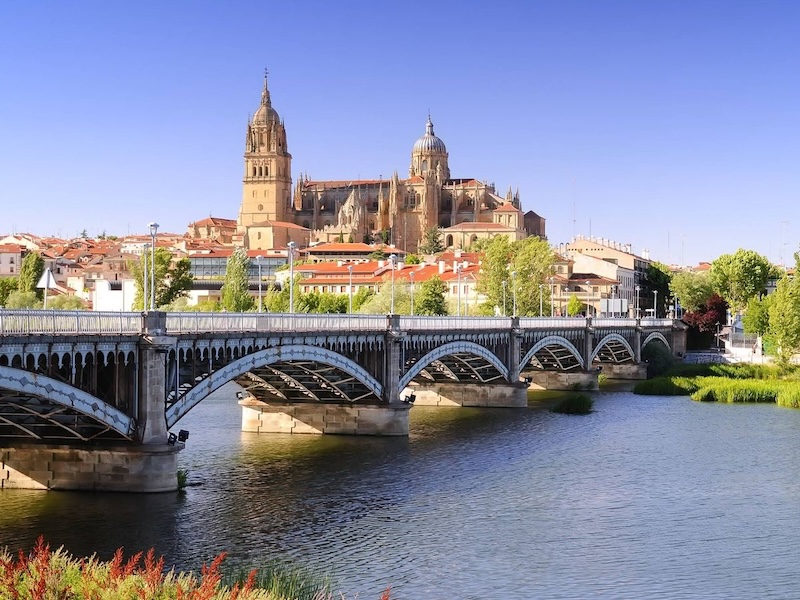
Salamanca
45 points of interest
Casa de las Conchas (House of Shells)
Must seeAttraction/Landmark
An iconic 15th-century Gothic palace whose facade is adorned with over 300 carved scallop shells, symbolizing the Order of Santiago. Now a public library, it remains one of Salamanca's most photographed landmarks.
Catedral Nueva de Salamanca (New Cathedral of Salamanca)
Must seeReligious
A magnificent late Gothic and Baroque cathedral built between the 16th and 18th centuries, famous for its ornate facade and the playful astronaut carving added during a 1992 restoration.
Catedral Vieja de Santa Maria (Old Cathedral of Salamanca)
Must seeReligious
A Romanesque gem from the 12th century featuring the striking Torre del Gallo dome and a breathtaking 15th-century altarpiece by Nicolás Florentino depicting 53 scenes from the life of Christ.
Museo Art Nouveau and Art Deco (Art Deco and Art Nouveau Museum)
Must seeMuseum/Gallery
Housed in the stunning Casa Lis, a modernist mansion with a spectacular stained-glass facade, this museum showcases an exquisite collection of Art Nouveau and Art Deco pieces including Lalique glass, Fabergé eggs, and bronze figurines.
Plaza Mayor (Main Square)
Must seeAttraction/Landmark
Widely regarded as Spain's most beautiful main square, this 18th-century Baroque masterpiece by Alberto Churriguera serves as Salamanca's vibrant social hub, with medallion portraits of Spanish kings and famous figures adorning its arches.
Universidad de Salamanca (University of Salamanca)
Must seeAttraction/Landmark
Founded in 1218, the oldest university in Spain and one of the oldest in Europe, famous for its spectacular Plateresque facade and its role as a cradle of Spanish Renaissance thought and international law.
Archaeological Park of St. Vincent's Hill
Attraction/Landmark
An open-air archaeological site on the Cerro de San Vicente revealing Salamanca's Iron Age origins, with remains of ancient dwellings dating back to the 7th century BC.
Augustinian Convent and Purisima Church
Religious
A stunning 17th-century Augustinian convent featuring the Purísima Church, home to one of Ribera's finest paintings — the Immaculate Conception — set within an elegant Renaissance cloister.
Casa de Santa Teresa (House of St. Therese)
Religious
The house where St. Teresa of Ávila stayed during her visits to Salamanca in the 16th century, now a small museum dedicated to the mystic saint and her connection to the city.
Church of St. Julian and St. Basilisa
Religious
One of Salamanca's oldest Romanesque churches, dating to the 12th century, with a simple yet charming facade and a peaceful interior that preserves the spirit of medieval devotion.
Cielo de Salamanca (Sky Over Salamanca)
Attraction/Landmark
A remarkable 15th-century ceiling fresco by Fernando Gallego depicting the zodiac and constellations, originally part of the university library and now displayed in the Escuelas Menores courtyard.
Colegio Mayor Arzobispo Fonseca (Archbishop Fonseca College)
Attraction/Landmark
A splendid 16th-century Renaissance college founded by Archbishop Alonso de Fonseca, featuring an elegant courtyard and a chapel with a beautiful Mudéjar-style ceiling.
Colegio de Calatrava (Calatrava College)
Attraction/Landmark
An imposing 18th-century Baroque college built for the Military Order of Calatrava, featuring a grand facade and now serving as a university residence and cultural venue.
Convento de San Esteban (Convent of St. Stephen)
Religious
A magnificent Dominican convent with one of Spain's finest Plateresque facades, where Christopher Columbus reportedly discussed his voyage plans with the friars before seeking royal support.
Convento de Santa Clara (St. Clara Convent)
Religious
A hidden treasure among Salamanca's convents, dating to the 13th century, where layers of Romanesque, Gothic, and Baroque frescoes were discovered beneath centuries of plaster on its walls.
Convento de la Anunciacion (Annunciation Convent)
Religious
Also known as the Úrsulas Convent, this 16th-century church houses the magnificent alabaster tomb of Archbishop Alonso de Fonseca, a masterpiece of Renaissance funerary art.
Convento de las Duenas (Duenas Convent)
Religious
A Dominican convent renowned for its extraordinary Renaissance cloister, whose upper gallery capitals feature fantastical and grotesque creatures that captivate every visitor.
Cueva de Salamanca (Salamanca Cave)
Attraction/Landmark
A legendary underground crypt where, according to medieval folklore, the Devil himself taught black magic and necromancy to students — a tale immortalized by Cervantes in one of his novellas.
DA2 Domus Artium 2002
Attraction/Landmark
Salamanca's contemporary art center, opened in 2002 when the city was European Capital of Culture, housed in a converted former prison and showcasing cutting-edge exhibitions and installations.
Escuelas Menores (Minor Schools)
Attraction/Landmark
The historic preparatory school of the University of Salamanca, built in the early 16th century with a beautiful Plateresque entrance, now housing the famous Cielo de Salamanca fresco.
Filmoteca de Castilla y Leon (Film Library of Castilla and Leon)
Attraction/Landmark
The regional film archive of Castilla y León, housed in a striking modern building, offering screenings, exhibitions, and a vast collection dedicated to preserving Spain's cinematic heritage.
General Archive of the Spanish Civil War
Attraction/Landmark
A significant historical archive preserving documents, photographs, and records from the Spanish Civil War (1936-1939), housed in a stately building and offering a sobering window into Spain's turbulent past.
Hospital del Estudio (Hospital of Study)
Attraction/Landmark
A 15th-century building originally serving as the university hospital for sick students, now home to the University of Salamanca's Rector's office, facing the iconic Patio de Escuelas.
Huerto de Calixto y Melibea (Garden of Calixto and Melibea)
Attraction/Landmark
A romantic terraced garden inspired by the literary lovers from Fernando de Rojas' 'La Celestina,' offering fragrant plants and stunning views of the cathedrals and the Tormes River valley.
Iglesia de San Benito (Church of St. Benedict)
Religious
A 15th-century Gothic church that served as the parish of one of Salamanca's most powerful noble lineages, with a fortress-like appearance reflecting the city's medieval clan rivalries.
Iglesia de San Juan de Sahagun (St. John of Sahagun Church)
Religious
A Baroque church dedicated to Salamanca's patron saint, San Juan de Sahagún, who was credited with miraculously ending the violent factional wars between the city's noble families in the 15th century.
Iglesia de San Marcos (St. Marcus Church)
Attraction/Landmark
A unique circular Romanesque church from the 12th century, one of very few round churches in Spain, originally linked to the Knights of the Order of St. John.
Iglesia de San Martin de Tours (Church of San Martin of Tours)
Religious
A 12th-century Romanesque church located in the heart of the city near the Plaza Mayor, featuring a notable northern portal with carved archivolt figures and centuries of layered architectural styles.
Iglesia de San Pablo (St. Paul Church)
Religious
A 17th-century Jesuit church built in a restrained Baroque style with a grand interior, once part of the Society of Jesus' educational complex in Salamanca.
Iglesia de la Vera Cruz (Church of the True Cross)
Religious
A striking 16th-century church famous for its elaborate Holy Week processions, serving as the seat of one of Salamanca's most important religious brotherhoods.
Mercado Central de Salamanca (Salamanca Central Market)
Shopping
A vibrant covered market in the heart of Salamanca where locals shop for fresh produce, Iberian ham, cheeses, and regional delicacies — a feast for the senses and a window into daily Castilian life.
Museo de Salamanca (Salamanca Museum)
Museum/Gallery
The provincial fine arts and archaeology museum housed in a beautiful 15th-century palace, featuring collections spanning prehistoric artifacts to paintings by Juan de Flandes and Luis de Morales.
Museo de Unamuno (Unamuno Museum)
Museum/Gallery
The former residence of Miguel de Unamuno during his years as rector of the University of Salamanca, now a museum preserving the personal belongings and writings of Spain's great philosopher and writer.
Palacio de Anaya (Anaya Palace)
Attraction/Landmark
A grand Neoclassical palace built in the late 18th century as the College of San Bartolomé, one of Spain's most prestigious university colleges, now part of the University of Salamanca's Faculty of Philology.
Palacio de Monterrey (Monterey Palace)
Attraction/Landmark
One of the finest examples of Spanish Plateresque civil architecture, this 16th-century palace owned by the House of Alba became so influential that it spawned an entire architectural style known as 'Monterrey style.'
Palacio de la Salina (Salina Palace)
Attraction/Landmark
A 16th-century palace named for its former use as a salt warehouse, featuring a striking courtyard with expressive carved medallions and corbels that are considered masterpieces of Renaissance sculpture.
Plaza de Anaya (Anaya Square)
Attraction/Landmark
One of Salamanca's most picturesque squares, framed by the New Cathedral's imposing facade and the Neoclassical Anaya Palace, offering one of the best vantage points to admire the cathedrals together.
Plaza de Toros de Salamanca (Salamanca Bullring)
Attraction/Landmark
A historic bullring built in 1893 with a capacity of nearly 11,000 spectators, located in a province renowned for its bull-breeding ranches and deeply rooted taurine traditions.
Pontifical University of Salamanca
Attraction/Landmark
A prestigious Catholic university founded in 1940 to continue the theological tradition of the original University of Salamanca, housed in a beautiful historic campus in the old quarter.
Puente Romano de Salamanca (Salamanca Roman Bridge)
Attraction/Landmark
An ancient bridge spanning the Tormes River with origins in the 1st century AD, part of the Roman Silver Route. Its southern arches are original Roman construction, while the northern ones were rebuilt after medieval floods.
Rana de Salamanca (Frog of Salamanca)
Attraction/Landmark
The most famous hidden detail in Spanish architecture — a tiny frog perched atop a skull on the university's Plateresque facade. Legend says students who find it without help will pass their exams.
Salamanca Automotive History Museum
Museum/Gallery
A fascinating museum showcasing a collection of vintage and classic automobiles tracing the evolution of the car from its earliest days to modern times, housed in a unique space near the old town.
St. Thomas Cantauriense Church
Religious
A small 12th-century Romanesque church dedicated to Thomas Becket, the martyred Archbishop of Canterbury — one of the earliest churches in Europe to honor the English saint.
The Clergy and Stairway to Heaven
Religious
The Clerecía, a monumental 17th-century Baroque Jesuit complex whose twin towers dominate Salamanca's skyline. Its 'Scala Coeli' rooftop tour offers breathtaking panoramic views of the golden city.
Torre del Clavero (Clavero Tower)
Attraction/Landmark
A striking 15th-century octagonal tower that is the last surviving remnant of a noble palace, built by the key-bearer (clavero) of the Order of Alcántara, with distinctive Mudéjar-influenced turrets.