Ronda
29 points of interest
Banos Arabes de Ronda (Arab Baths of Ronda)
Must seeAttraction/Landmark
Among the best-preserved Moorish baths in the Iberian Peninsula, these 13th-century baths feature star-shaped skylights and horseshoe arches that reveal Ronda's Islamic heritage.
Plaza de Toros de Ronda (Ronda Bullring)
Must seeAttraction/Landmark
One of the oldest and most majestic bullrings in Spain, built in 1785 in neoclassical style, and considered the birthplace of modern bullfighting under the legendary Romero dynasty.
Puente Nuevo (New Bridge)
Must seeAttraction/Landmark
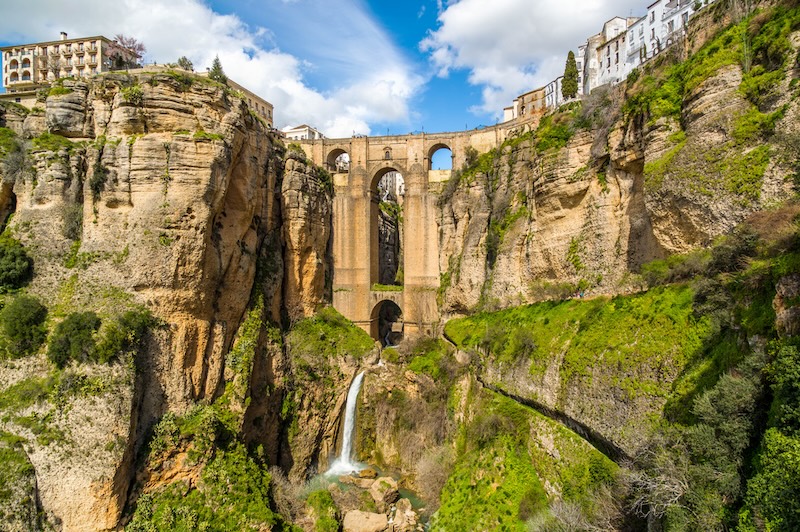
Ronda's iconic 18th-century stone bridge soaring 98 meters above the El Tajo gorge, connecting the old Moorish town with the newer Mercadillo quarter in a breathtaking feat of engineering.
Tajo de Ronda (Ronda Gorge)
Must seeAttraction/Landmark
The dramatic 100-meter-deep gorge carved by the Guadalevín River that splits Ronda in two, creating the vertiginous cliffs that have defined the city's identity for centuries.
Alameda del Tajo (Gorge Promenade)
Attraction/Landmark
A stunning 19th-century promenade perched on the edge of the El Tajo gorge, offering panoramic views of the Serranía de Ronda mountains and the valley below.
Bodega Descalzos Viejos (Descalzos Viejos Winery)
Food/Drink
A boutique winery set inside a restored 16th-century Trinitarian monastery, producing award-winning organic wines in the heart of the Ronda wine region.
Bodega Dona Felisa (Dona Felisa Winery)
Food/Drink
A family-run estate winery in the Ronda highlands known for its innovative blends and stunning vineyard views across the Serranía de Ronda landscape.
Bodega Garcia Hidalgo (Garcia Hidalgo Winery)
Food/Drink
A small artisan winery near Ronda producing handcrafted wines from local grape varieties, offering intimate tastings with a personal touch.
Bodega Joaquín Fernández (Joaquin Fernandez Winery)
Food/Drink
A pioneering organic winery in the Ronda appellation, where traditional winemaking meets sustainable practices amid rolling Andalusian hillsides.
Carrera Espinel Shopping Street
Shopping
Ronda's lively main shopping street, locally known as "La Bola," lined with tapas bars, boutiques, and cafés that capture the essence of daily Andalusian life.
Casa de San Juan Bosco (San Juan Bosco House)
Museum/Gallery
An elegant early 20th-century mansion perched on the gorge's edge, celebrated for its beautifully tiled patios and terraced gardens with breathtaking views of the Tajo.
Casa del Rey Moro (House of the Moorish King)
Attraction/Landmark
An 18th-century palace built on Moorish foundations, featuring a secret water mine with 231 steps carved into the cliff face descending to the river at the bottom of the gorge.
Iglesia de Nostra Senora de la Merced (Church of Our Lady of Mercy)
Religious
A graceful Baroque church originally founded by the Mercedarian order, with an ornate façade and a serene interior that reflect Ronda's rich religious heritage.
Iglesia de Padre Jesus (Father Jesus Church)
Religious
A 16th-century Gothic-Renaissance church in the old town, home to a deeply venerated image of Christ that is central to Ronda's Semana Santa processions.
Iglesia de Santa Maria la Mayor (Church of Saint Mary the Elder)
Religious
Built over the city's former main mosque, this church blends Gothic, Renaissance, and Baroque styles, with a Mudejar tower and a gallery overlooking the Plaza Duquesa de Parcent.
Iglesia del Espiritu Santo (Church of the Holy Spirit)
Religious
A fortress-like 16th-century church ordered by King Ferdinand the Catholic after the reconquest of Ronda, with thick walls and a sober Gothic interior.
Iglesia del Socorro (Church of Help)
Religious
A neoclassical church presiding over the Plaza del Socorro, serving as the social heart of modern Ronda where locals gather in the surrounding cafés and terraces.
Museo Lara (Lara Museum)
Museum/Gallery
Housed in the Palacio de los Condes de las Conquistas, this eclectic museum showcases a vast private collection spanning clocks, weapons, scientific instruments, and cinema memorabilia.
Museo Unicaja Joaquin Peinado (Joaquin Peinado Unicaja Museum)
Museum/Gallery
Dedicated to Ronda-born painter Joaquín Peinado, a contemporary of Picasso, this museum in the Palacio de Moctezuma displays his Cubist and abstract works.
Palacio de Mondragon (Mondragon Palace)
Attraction/Landmark
Originally a Moorish palace later remodeled after the Christian reconquest, it now houses Ronda's municipal museum and features stunning Mudejar courtyards and cliff-hanging gardens.
Palacio de Salvatierra (Salvatierra Palace)
Attraction/Landmark
A Renaissance-era noble residence near the Old Bridge, notable for its ornate wrought-iron balcony and carved stone figures flanking the main doorway.
Paseo de Blas Infante (Blas Infante Park)
Parks & Gardens
A scenic viewpoint and promenade named after the father of Andalusian nationalism, offering one of the most iconic photo spots of the Puente Nuevo and the gorge.
Plaza Duquesa de Parcent (Duchess of Parcent Square)
Attraction/Landmark
The elegant main square of Ronda's old town, framed by the Church of Santa María la Mayor, the Town Hall, and traditional whitewashed buildings with orange trees.
Plaza de Espana (Spain Square)
Attraction/Landmark
A bustling square at the entrance to the Puente Nuevo, anchored by the former town hall (now a Parador), and serving as the gateway between old and new Ronda.
Plaza del Socorro (Socorro Square)
Attraction/Landmark
The vibrant social hub of Ronda's new town, surrounded by restaurants and shops, centered around a fountain and the neoclassical Church of Socorro.
Puente Romano (Roman Bridge)
Attraction/Landmark
Despite its name, this single-arch bridge at the base of the gorge dates to the 14th century and offers a stunning perspective of the towering cliffs and the Puente Nuevo above.
Puente Viejo (Old Bridge)
Attraction/Landmark
A 17th-century stone bridge rebuilt over an earlier Moorish crossing, spanning the narrowest section of the gorge and linking the old quarter to the riverbank paths below.
Puerta de Felipe V (Gate of Felipe V)
Attraction/Landmark
An 18th-century Baroque stone gate commissioned by King Philip V, marking the historic entrance to the old town from the river valley and the Arab Quarter below.
Puerta del Almocabar (Almocabar Gate)
Attraction/Landmark
A 13th-century fortified gateway that served as the main entrance to the Moorish citadel, its massive horseshoe arches still standing as a testament to Ronda's medieval defenses.