Cartagena
12 points of interest
Calle Mayor (Main Street)
Must seeShopping
Cartagena's grand pedestrian boulevard stretching from the port to the old town, the Calle Mayor is lined with stunning Art Nouveau and modernist buildings from the city's early 20th-century mining boom, including the ornate Casino and the Casa Cervantes, making it an open-air architectural showcase.
Museo Foro Romano Molinete (Roman Forum Molinete Museum)
Must seeMuseum/Gallery
An extraordinary archaeological park on the Molinete hill showcasing the excavated remains of the Roman Forum of Carthago Nova, featuring a remarkably preserved thermal bath complex with original floor mosaics, the Atrium building with painted walls, and the Augusteum — all brought to life through modern museum displays and walkways.
National Museum of Subaquatic Archaeology
Must seeMuseum/Gallery
Spain's national museum dedicated to underwater archaeology, housed in a striking modern building on the waterfront designed to resemble a ship, the ARQUA museum showcases treasures recovered from ancient shipwrecks including Phoenician, Roman, and medieval vessels, with a special focus on maritime trade routes of the Mediterranean.
Roman Theatre
Must seeAttraction/Landmark
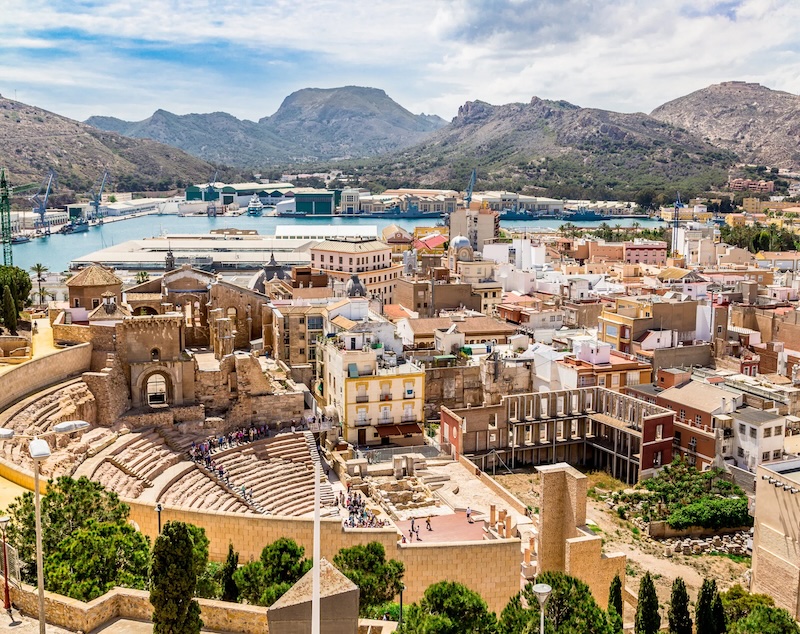
One of the most impressive Roman monuments in Spain, Cartagena's Roman Theatre was built in the 1st century BC during the reign of Augustus, seating up to 6,000 spectators, and remained hidden for centuries beneath medieval buildings until its extraordinary rediscovery in 1988, now magnificently restored and open to visitors.
Augusteum
Museum/Gallery
The excavated remains of a Roman building dedicated to the worship of Emperor Augustus, the Augusteum dates from the 1st century BC and features remarkably preserved painted walls, mosaic floors, and ceremonial chambers that once served as the headquarters for the Augustales priests in ancient Carthago Nova.
Cartagena Naval Museum
Museum/Gallery
A comprehensive maritime museum housed in a grand 18th-century naval building on the waterfront, showcasing Cartagena's 3,000-year naval history through ship models, navigation instruments, cannons, torpedoes, and the famous Peral submarine — one of the world's first electric-powered submersibles, invented here in 1888.
Casa de la Fortuna (House of Fortune)
Attraction/Landmark
A remarkably well-preserved 1st-century BC Roman domus discovered in the heart of the city, the Casa de la Fortuna features stunning original mosaic floors, painted wall frescoes, and domestic artifacts that offer an intimate glimpse into the luxurious private life of a wealthy Roman citizen in Carthago Nova.
Castillo de la Concepción (Castle of the Conception)
Attraction/Landmark
A medieval castle perched atop the highest of Cartagena's five hills, the Castillo de la Concepción was built over Punic and Roman ruins and now houses a history museum interpreting the city's past from Carthaginian times, while its ramparts offer the finest panoramic views over the port and the entire city.
Catedral de Santa Maria La Mayor (Cathedral of Saint Mary the Great)
Religious
The atmospheric ruins of Cartagena's oldest church, dating back to the 13th century and built atop the ruins of the Roman Theatre, the Cathedral of Santa María la Vieja was heavily damaged during the Spanish Civil War and now stands as a hauntingly beautiful open-air monument with visible Roman columns incorporated into its walls.
City Hall
Attraction/Landmark
A magnificent modernist building completed in 1907, Cartagena's City Hall is one of the finest examples of Art Nouveau architecture in Spain, featuring a white marble facade, an ornate triangular pediment, twin cupolas, and a ground floor with open arches that allows views through to the old town beyond.
Columnata Romana (Roman Colonnade)
Attraction/Landmark
An impressive row of Roman columns discovered during urban renovation works, the Columnata Romana stands along a major street as a striking reminder of the ancient Roman portico that once lined the commercial heart of Carthago Nova, now preserved in situ and integrated into the modern cityscape.
Municipal Archaeological Museum of Cartagena
Museum/Gallery
A museum housing an extensive collection of artifacts spanning from Iberian and Punic periods through the Roman era, including ceramics, coins, funerary objects, and sculpture fragments that document the rich archaeological heritage of Cartagena and its surrounding region across millennia of continuous settlement.
Museo Del Teatro Romano (Roman Theater Museum of Cartagena)
Museum/Gallery
Designed by architect Rafael Moneo, this award-winning museum provides a dramatic underground journey through the layers of Cartagena's history, guiding visitors from the modern city through medieval corridors and Byzantine walls until they emerge into the spectacular Roman Theatre, hidden for centuries beneath the old cathedral.
Punic wall of Cartagena
Attraction/Landmark
One of the very few surviving examples of Carthaginian military architecture in Europe, this 3rd-century BC defensive wall was built by the Carthaginians to protect their strategic Mediterranean port city of Qart Hadasht, featuring massive sandstone blocks and an interpretive center explaining the Punic Wars that shaped the western Mediterranean.