Cádiz
41 points of interest
Cadiz Cathedral and Square
Must seeReligious
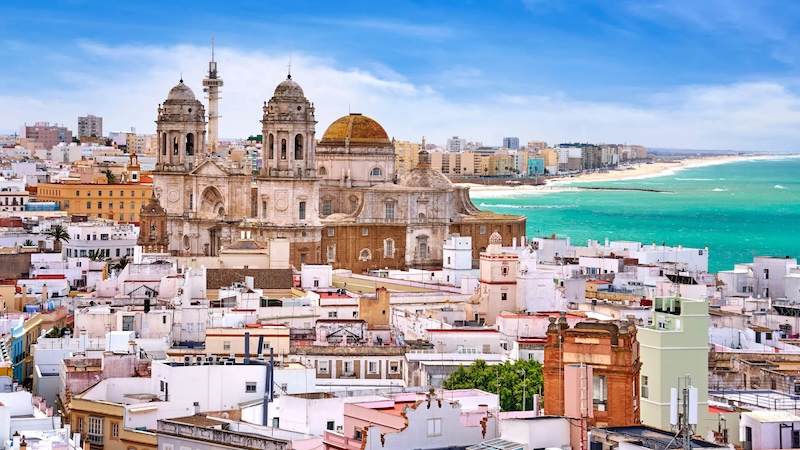
A magnificent 18th-century cathedral whose golden dome dominates the Cádiz skyline, blending Baroque, Rococo, and Neoclassical styles over its long construction, with a crypt below sea level, a treasury of sacred art, and a climbable tower offering breathtaking 360-degree views of the ocean-surrounded city.
Mercado Central (Central Market)
Must seeShopping
A vibrant neoclassical market hall built in 1838 on the site of a former Franciscan orchard, the Mercado Central de Cádiz buzzes with stalls selling the freshest Atlantic seafood, local cheeses, sherry wines, and Andalusian produce, offering visitors an authentic taste of gaditano culinary culture.
Parque Genoves (Genoves Park)
Must seeParks & Gardens
A lush botanical garden on the western tip of the old city overlooking the Atlantic Ocean, the Parque Genovés is filled with exotic trees, sculpted topiary, a waterfall grotto, and a pond with ducks, offering one of the most enchanting green spaces on the Andalusian coast with spectacular ocean views.
Playa Victoria (Victoria Beach)
Must seeParks & Gardens
Cádiz's longest and most popular beach stretching nearly three kilometers along the Atlantic coast, Playa Victoria boasts golden sand, excellent water quality with a Blue Flag designation, a lively promenade lined with restaurants and chiringuitos, and stunning sunsets over the open ocean.
Playa de La Caleta (La Caleta Beach)
Must seeParks & Gardens
The most iconic beach in Cádiz, this small crescent of golden sand nestled between the castles of San Sebastián and Santa Catalina has been a natural harbour since Phoenician times, featured in the James Bond film 'Die Another Day', and remains the beloved heart of old Cádiz's seafront.
Torre Tavira (Tavira Tower)
Must seeAttraction/Landmark
The highest watchtower in Cádiz at 45 meters above sea level, the Torre Tavira was the city's official maritime lookout in the 18th century and now houses a camera obscura that projects a stunning live panoramic image of the city onto a concave screen, offering a unique way to explore Cádiz from above.
Arco de los Blanco (Arch of the Whites)
Attraction/Landmark
A 13th-century gateway arch that once formed part of the medieval city walls, the Arco de los Blancos takes its name from the noble Blanco family whose palace stood beside it, marking the entrance to the oldest quarter of Cádiz near the Roman Theatre.
Ayuntamiento de Cadiz (Cadiz City Hall)
Attraction/Landmark
An elegant neoclassical and Isabelline-style building overlooking the Plaza de San Juan de Dios, Cádiz's City Hall was built in two phases in the early 19th and early 20th centuries, featuring a grand facade with Ionic columns and a central clock tower that has become a landmark of the city's waterfront.
Balneario de Nuestra Senora de la Palma y del Real (Spa of Our Lady of La Palma and Real)
Attraction/Landmark
A charming historic seaside bathhouse dating from the early 20th century, this elegant spa pavilion sits on the edge of La Caleta beach, its white Moorish-inspired architecture evoking the golden era of coastal leisure and serving as one of Cádiz's most recognizable and photogenic landmarks.
Baluarte de la Candelaria (Candelaria Bastion)
Attraction/Landmark
A 17th-century coastal fortress built to defend Cádiz from naval attacks, the Candelaria Bastion juts out into the Atlantic Ocean with its thick stone walls and cannon embrasures, now serving as a cultural venue and offering dramatic sunset views over the open sea.
Barrio de la Vina (Neighborhood of the Vine)
Attraction/Landmark
The most authentic and lively neighborhood in Cádiz, the Barrio de la Viña is the traditional home of Carnival culture, flamenco, and fried fish, with narrow streets filled with colorful facades, local tabernas, and an irresistible atmosphere that pulses with the spirit of gaditano life.
Casa del Almirante (House of the Admiral)
Attraction/Landmark
A splendid 17th-century Baroque palace built for Admiral Diego de Barrios with wealth from the Americas trade, the Casa del Almirante features an exquisite Italian marble facade with Genoese-style columns and balconies, reflecting the prosperity Cádiz enjoyed as Spain's gateway to the New World.
Castillo de San Sebastian (Castle of San Sebastian)
Attraction/Landmark
A dramatic 18th-century fortress perched on a small island at the end of a long stone causeway stretching into the Atlantic, the Castle of San Sebastián was built on the legendary site of a Phoenician temple and now hosts cultural exhibitions within its weathered walls surrounded by crashing waves.
Castillo de Santa Catalina (Castle of Santa Catalina)
Attraction/Landmark
A star-shaped fortress built in 1598 by order of King Philip II after the devastating English raid on Cádiz, the Castle of Santa Catalina guards the northern end of La Caleta beach and now serves as a free cultural space with art exhibitions and stunning views of the bay.
Clara Campoamor Promenade
Attraction/Landmark
A scenic oceanfront promenade named after the Spanish feminist and politician Clara Campoamor, this walkway stretches along the northern coast of Cádiz offering unobstructed views of the Atlantic, fresh sea breezes, and a pleasant path connecting the old town to the newer districts.
Convento de San Francisco (Convent of San Francisco)
Religious
A 16th-century Franciscan convent with a beautiful Baroque church and cloister, the Convento de San Francisco has been restored as a cultural center while preserving its atmospheric courtyards and religious artwork, standing as a peaceful retreat amid the bustling streets of central Cádiz.
Gran Teatro Falla (Grand Theatre Falla)
Attraction/Landmark
A striking Neo-Mudéjar theatre built in red brick with horseshoe arches, named after the Cádiz-born composer Manuel de Falla, the Gran Teatro is famous as the main stage for the city's legendary Carnival singing competitions, the Concurso Oficial de Agrupaciones Carnavalescas.
Hospital de Nuestra Senora del Carmen (Hospital of Our Lady of Carmen)
Attraction/Landmark
A grand 18th-century Baroque building originally built as a hospital by the Carmelite order, this imposing structure features a beautiful chapel, ornate stonework, and an elegant courtyard, reflecting the wealth and charitable spirit of Cádiz during the height of the transatlantic trade era.
Iglesia de Santa Cruz (Church of the Holy Cross)
Religious
The original cathedral of Cádiz before the new one was built, the Church of Santa Cruz dates from the 13th century and was rebuilt after the 1596 English attack, standing atop Roman and Visigothic foundations with a simple yet beautiful interior and remnants of medieval frescoes.
Iglesia de Santiago (Church of Santiago)
Religious
One of the oldest parish churches in Cádiz dating from the 15th century, the Church of Santiago features a notable Gothic portal and a richly decorated Baroque interior with gilded altarpieces, standing in the heart of the old town as a testament to the city's deep religious heritage.
Iglesia de Santo Domingo (Church of Santo Domingo)
Religious
A 17th-century Dominican church with a striking Mannerist facade and a revered collection of Baroque religious sculptures, the Church of Santo Domingo is renowned for its dramatic Holy Week processions and its ornate side chapels filled with gilded woodwork and devotional art.
Iglesia del Oratorio de San Felipe Neri (Church of Oratorio de San Felipe Neri)
Religious
A historic Baroque church with a striking elliptical plan and a Murillo painting of the Immaculate Conception, the Oratorio de San Felipe Neri holds immense national significance as the place where Spain's first liberal constitution, the famous Constitution of 1812, was drafted and proclaimed.
Museo Taller Litografico (Lithographic Workshop Museum)
Museum/Gallery
A unique museum dedicated to the art of lithography, housed in a historic building near the Puerta de Tierra, preserving antique printing presses, stone plates, and original prints that document the important role Cádiz played in the history of printing and graphic arts in Spain.
Museo de Cadiz (Museum of Cadiz)
Museum/Gallery
The main museum of the city housed in a grand neoclassical building on Plaza de Mina, the Museum of Cádiz combines an exceptional archaeological collection featuring Phoenician marble sarcophagi with a fine arts gallery holding works by Zurbarán, Murillo, and Rubens across its elegant halls.
Museo de las Cortes de Cadiz (The Cortes Museum of Cadiz)
Museum/Gallery
A museum dedicated to the historic Cortes of Cádiz and the Constitution of 1812, known as 'La Pepa', housing documents, paintings, and a remarkable large-scale model of the city as it appeared in the early 19th century, commemorating one of the most pivotal moments in Spanish democratic history.
Museo del Títere de Cadiz (The Puppet Museum of Cadiz)
Attraction/Landmark
A delightful museum celebrating the art of puppetry from around the world, housed in the Puerta de Tierra, with an enchanting collection of marionettes, shadow puppets, and hand puppets that highlights the deep connection between puppetry and Cádiz's famous Carnival tradition.
Oratorio de la Santa Cueva (Oratory of the Holy Cave)
Attraction/Landmark
A remarkable 18th-century oratory with two contrasting levels — a sober underground chapel for penitence and an exquisite upper chapel adorned with three ceiling paintings by Francisco de Goya depicting scenes of the Eucharist, making it one of the most important artistic treasures in Cádiz.
Palacio de Mora (Mora Palace)
Attraction/Landmark
An elegant 18th-century noble palace reflecting the wealth of Cádiz's merchant class during the colonial trade era, the Palacio de Mora features a refined neoclassical facade, a grand marble staircase, and richly decorated salons that speak to the opulent lifestyle of the city's aristocratic families.
Paseo de Canalejas (Canalejas Walk)
Attraction/Landmark
A pleasant tree-lined promenade along the eastern waterfront of the old town, the Paseo de Canalejas offers beautiful views of the bay, the port, and the distant mountains of the coast, serving as a popular spot for evening strolls and connecting the old town with the commercial district.
Playa de Santa Maria del Mar (Santa Maria del Mar Beach)
Parks & Gardens
A quieter urban beach sheltered between rocky breakwaters south of the old town, Playa de Santa María del Mar offers a more relaxed atmosphere than Victoria Beach, with calm waters, a small promenade, and a local neighborhood feel favored by Cádiz residents over tourists.
Plaza de España (Square of Spain)
Attraction/Landmark
A grand waterfront square dominated by an imposing monument commemorating the 1812 Constitution, the Plaza de España sits at the edge of the old town near the port, featuring a semicircular colonnade and symbolic sculptures celebrating Cádiz's role as the birthplace of Spanish constitutional democracy.
Plaza de Las Flores (Flower Square)
Attraction/Landmark
One of the most charming squares in Cádiz, the Plaza de las Flores takes its name from the traditional flower stalls that have operated here for centuries, surrounded by buzzing tapas bars, the post office with its ornate facade, and the lively energy of daily gaditano life.
Plaza de Mina (Mina Square)
Attraction/Landmark
The largest and most elegant square in Cádiz, the Plaza de Mina is a leafy oasis surrounded by grand neoclassical buildings, home to the Museum of Cádiz, and shaded by towering ficus and palm trees, serving as a tranquil retreat and cultural meeting point in the heart of the city.
Plaza de San Antonio (San Antonio Square)
Attraction/Landmark
A stately square with deep historical significance, the Plaza de San Antonio is where the 1812 Constitution was first publicly proclaimed, flanked by the Church of San Antonio and elegant 18th-century townhouses, and now hosting a popular café scene beneath its mature trees.
Plaza de San Juan de Dios (Saint John of God Square) and Old Town Hall
Attraction/Landmark
The main gateway to the old town from the port, the Plaza de San Juan de Dios is Cádiz's most bustling square, dominated by the imposing City Hall with its twin towers, surrounded by palm trees and terrace cafes, and buzzing with life as the natural meeting point for visitors arriving by sea.
Plaza de la Candelaria (Candelaria Square)
Attraction/Landmark
A picturesque square in the heart of the old town named after the nearby Candelaria church, the Plaza de la Candelaria features a central fountain, towering dragon trees, and surrounding historic buildings, serving as a peaceful crossroads between the city's most important streets and landmarks.
Puente de la Constitucion de 1812 (Bridge of the 1812 Constitution)
Attraction/Landmark
A spectacular modern cable-stayed bridge completed in 2015, stretching over 3 kilometers across the Bay of Cádiz with a soaring 185-meter pylon, connecting the old city to the mainland and named in honor of the historic 1812 Constitution, making it one of the longest bridges in Spain.
Puerta de Tierra (Earth Gate)
Attraction/Landmark
The monumental 18th-century fortified gateway that marks the only land entrance to the old city of Cádiz, the Puerta de Tierra features massive stone walls, a Baroque facade with a marble statue of San Servando, and now houses the Puppet Museum within its imposing bastions.
Puerta del Barrio de Santa María (Gate of the district of Santa Maria)
Religious
A historic archway marking the entrance to the Barrio de Santa María, one of Cádiz's oldest and most atmospheric neighborhoods, known for its narrow winding streets, flamenco heritage, and the vibrant local culture that has made it the traditional heart of the city's Roma community.
Teatro Romano (Roman Theatre)
Attraction/Landmark
One of the largest Roman theatres ever discovered in Spain, Cádiz's Roman Theatre dates from the 1st century BC and was only rediscovered in 1980 beneath the old town, its excavated galleries and seating rows offering a fascinating window into the city's ancient past as the Roman colony of Gades.
Yacimiento Arqueologico Gadir (Gadir Archaeological Site)
Attraction/Landmark
A remarkable underground archaeological site revealing the remains of a Phoenician settlement from the 9th century BC, the Gadir site is one of the oldest urban settlements in Western Europe, featuring preserved dwellings, streets, and artifacts that illuminate the founding of Cádiz over 3,000 years ago.