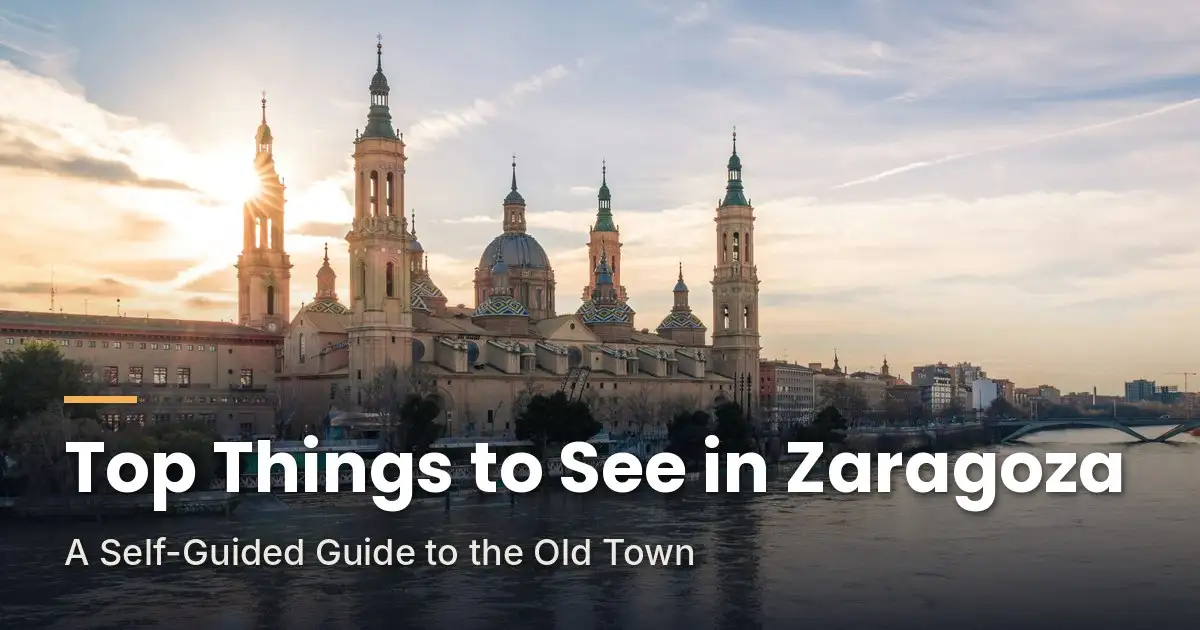
Zaragoza is one of Spain's most underrated cities. It is the capital of Aragon and the fifth-largest city in the country. It sits on the Ebro River, about halfway between Madrid and Barcelona. Many travellers only see it through a train window, but a stop here rewards you with Roman ruins, an Islamic palace, Baroque domes and some of Spain's best tapas lanes.
The Romans founded the city as Caesaraugusta, after the emperor Augustus, and "Zaragoza" grew out of that name. Two thousand years of history are packed into a compact centre that is easy to explore on foot. This guide covers the top things to see in Zaragoza, a simple one-day itinerary, what to eat, and how to explore it all at your own pace.
1. Basilica del Pilar and Plaza del Pilar
Start with the city's symbol. The Basilica del Pilar is a huge Baroque church with four towers and domes covered in coloured tiles. It is one of the most important pilgrimage sites in Spain, built around the pillar where, according to tradition, the Virgin Mary appeared to Saint James.
Inside, look up: the young Francisco de Goya painted frescoes in some of the domes. Near one of the chapels you can see two bombs dropped on the basilica during the Spanish Civil War in 1936, which never exploded.
For the best view, take the lift up the Torre del Pilar, one of the basilica's towers. From the top you see the domes up close, the Ebro and the rooftops of the old town.
Outside, Plaza del Pilar is one of the longest pedestrian squares in Spain. It links the basilica with the cathedral and the town hall, and it is a great place to start your walk.
2. La Seo (Cathedral of the Saviour)
At the eastern end of the square stands La Seo, Zaragoza's other cathedral. It mixes almost every style in Spanish architecture, from Romanesque to Baroque. Walk around the back to see its Mudéjar wall, decorated with brick patterns and glazed ceramics.
That wall is part of the UNESCO World Heritage listing for the Mudéjar Architecture of Aragon. Mudéjar is a style created by Muslim craftsmen working under Christian rule, and Aragon has some of its finest examples.
3. La Lonja
Between the basilica and La Seo you will find La Lonja, a 16th-century merchants' exchange. It is one of the finest Renaissance buildings in Aragon, with slender columns and a decorated ceiling. Today it hosts temporary exhibitions.
4. Puente de Piedra and the Ebro Riverside
Walk down to the Puente de Piedra (Stone Bridge), which has crossed the Ebro since the Middle Ages. Bronze lions guard both ends. Cross to the far bank and turn around: this is the classic postcard view of Zaragoza, with the basilica's domes reflected in the river. It is especially beautiful at sunset.
5. Roman Zaragoza
Caesaraugusta left plenty behind. Near the Mercado Central, a long stretch of the Roman walls survives, with a statue of Augustus beside it. Several other Roman sites lie under the old town, including the forum, the river port, the baths and a theatre, and some can be visited as small museums.
6. Aljafería Palace
A short walk west of the centre stands the Aljafería Palace, one of the most remarkable things to see in Zaragoza. It was built in the 11th century as the palace of the city's Muslim rulers. Later it became a residence of the Christian kings of Aragon and of the Catholic Monarchs.
Its courtyard of intertwined arches is a rare survivor of Islamic palace architecture from this period in Spain. Today the palace is also home to the Aragonese parliament, the Cortes de Aragón, so check opening times before you go.
7. Goya's Zaragoza
Francisco de Goya was born in Fuendetodos, a village south of Zaragoza, and trained in the city. Besides his frescoes in the basilica, the Museo Goya – Colección Ibercaja shows his paintings and his famous print series. The Museo de Zaragoza also holds works by Goya, along with archaeology from the region.
8. Santa Engracia
On the way to or from the train area, stop at the Church of Santa Engracia. Its carved stone façade, from the early 16th century, is one of the most detailed in the city.
9. Mercado Central and El Tubo
The Mercado Central is a handsome early 20th-century market hall of iron and glass, full of stalls selling local produce. It is a good stop to see how the city shops and eats.
When it is time for tapas, head to El Tubo, a maze of narrow lanes near Plaza de España packed with small bars. Hop from one to the next and order a little at each one, as the locals do.
Zaragoza Itinerary: One Day on Foot
Zaragoza's centre is flat and compact, so you can see the highlights in a day:
- Morning: Basilica del Pilar and the Torre del Pilar, then La Lonja and La Seo.
- Late morning: Roman walls and Mercado Central.
- Lunch: tapas in El Tubo, reached along Calle Alfonso I, the elegant shopping street that frames the basilica's domes.
- Afternoon: walk west to the Aljafería Palace, or choose the Goya museum if you prefer art.
- Sunset: cross the Puente de Piedra for the view of the basilica over the Ebro.
If you arrive by train, high-speed services connect Zaragoza-Delicias station with Madrid and Barcelona, which makes Zaragoza an easy stopover between the two.
What to Eat in Zaragoza
Aragonese cooking is simple and hearty. Look out for:
- Ternasco de Aragón: young lamb, usually roasted, the region's signature dish.
- Migas: fried breadcrumbs with garlic and pork, a shepherd's classic.
- Borraja: borage, a local vegetable often served with potatoes.
- Frutas de Aragón: candied fruit coated in chocolate, a classic gift to take home.
Tips for Visiting Zaragoza
- Pack a layer. The city is known for the cierzo, a strong, cold north-west wind that can make winter days feel colder than they are.
- Check opening times. Churches and monuments set their own hours, and the Aljafería's opening can change around parliamentary activity.
- Walk the river. The Ebro riverside paths are a relaxing way to link the sights.
Explore Zaragoza at Your Own Pace with Tour Me On
The best way to see Zaragoza is to wander, and to know the story behind what you are looking at. Tour Me On is a self-guided audio guide app for Spanish cities. Its Zaragoza audio guide has 14 stops, including the Basilica del Pilar, the Torre del Pilar viewpoint, La Seo, the Aljafería Palace, the Puente de Piedra, the Roman walls, the Mercado Central and El Tubo.
- Stories, not lectures: most stops last about 3 to 7 minutes, narrated in English or Spanish.
- No fixed route: open the map and listen to whatever is around you.
- Free to try: the app is free to download, every stop has a free audio preview, and with a free account your first 3 full stories are free.
- One-time purchase: unlock all of Zaragoza for €2.99, with no subscription.
- Works offline: download the guide before your trip and explore without Wi-Fi or mobile data.
Download Tour Me On on the App Store or Google Play and let Zaragoza tell you its story, one stop at a time.