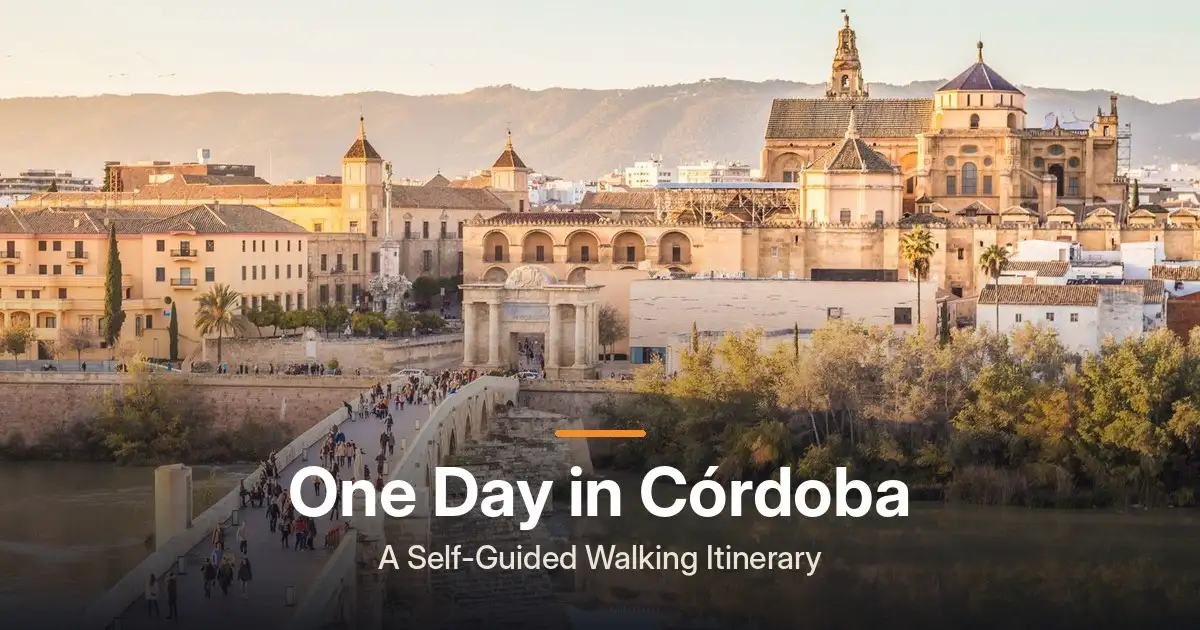
Córdoba packs two thousand years of history into a compact old town you can cross on foot in twenty minutes. Roman engineers built its bridge, Umayyad caliphs made it one of the great cities of medieval Europe, and Christian kings later planted a cathedral inside its most famous mosque. If you only have one day in Córdoba, a well-planned walking route lets you see the highlights without rushing from ticket queue to ticket queue.
This Córdoba itinerary follows a simple loop: start at the river, spend the morning in the Mezquita and the Jewish Quarter, take the afternoon for the Alcázar gardens and quieter squares, and end with tapas as the light fades. It works just as well as a Córdoba day trip from Seville or Madrid by high-speed train.
Getting there and getting around
Córdoba sits on Spain's main high-speed rail line between Madrid and Seville. The ride from Seville takes under an hour, and from Madrid roughly two, so a day trip is easy. From the train station, the old town is about a 25-minute walk or a short taxi ride. Once you are in the historic centre, leave the map app in your pocket: the lanes are narrow, the distances short, and getting a little lost is half the fun.
Morning: the Roman Bridge and the Mezquita
Start at the Roman Bridge
Begin your day at the Puente Romano, the Roman Bridge that has crossed the Guadalquivir River since the first century BC. It was rebuilt many times over the centuries, but its arches still frame the classic view of the city: the bell tower of the Mezquita rising above the rooftops. At the south end stands the Torre de la Calahorra, a medieval gate tower that now houses a museum about life in al-Andalus. At the north end, the Renaissance Puerta del Puente gate leads you straight into the old town.
Early morning is the best moment here. The light is soft, the river is calm, and you will share the bridge with joggers rather than tour groups.
Visit the Mezquita-Catedral
The Mezquita-Catedral of Córdoba is the reason most people come, and it deserves at least an hour and a half. Construction began in the late 8th century under Abd al-Rahman I and the building was enlarged several times as the city grew into the capital of the Caliphate of Córdoba. Step inside and you meet the famous forest of columns topped with red-and-white striped double arches, followed by the richly decorated mihrab, one of the finest pieces of Islamic art in Europe.
Then comes the surprise: a Renaissance cathedral built in the middle of the prayer hall in the 16th century. Seeing the two styles side by side is what makes the Mezquita unlike anywhere else. Before or after your visit, take a few minutes in the Patio de los Naranjos, the orange-tree courtyard that was once the mosque's ablutions court. It is free to enter and a peaceful spot to sit.
The Mezquita and the surrounding historic centre are a UNESCO World Heritage Site. Check the official website for current opening hours and tickets before you go, and book ahead if you are visiting at a weekend or on a holiday.
Late morning: the Jewish Quarter
Wander the Judería
Just north and west of the Mezquita lies the Judería, Córdoba's old Jewish Quarter. This maze of whitewashed lanes, flower pots and wrought-iron balconies is the most photogenic part of the city and one of its best hidden gems for slow walkers.
Don't miss these stops:
- Calleja de las Flores, a tiny lane lined with flower pots that frames the Mezquita's bell tower at its end.
- The Synagogue of Córdoba, a small 14th-century synagogue with delicate plasterwork, one of the few medieval synagogues that survive in Spain.
- The statue of Maimonides, the 12th-century philosopher and physician born in Córdoba, in a little square near the synagogue.
- The Puerta de Almodóvar, a medieval gate in the old city walls on the edge of the quarter.
This is also where you will find Córdoba's famous patios: courtyards filled with plants and flowers, the stars of the city's Patios Festival each May. Many are private homes, so admire them from the doorway unless a sign invites you in.
Lunch: try the local classics
Córdoba has a proud food culture, and lunch is the main meal of the day in Andalusia. Look for these dishes:
- Salmorejo: a thick, cold tomato and bread cream topped with ham and egg, born in Córdoba.
- Flamenquín: rolled pork wrapped around ham, breaded and fried.
- Rabo de toro: slow-cooked oxtail stew.
- Berenjenas con miel: fried aubergine drizzled with cane honey.
Avoid the restaurants directly facing the Mezquita and walk a few streets away for better value and a more local crowd.
Afternoon: gardens, temples and squares
The Alcázar de los Reyes Cristianos
A short walk from the Judería, the Alcázar de los Reyes Cristianos is a fortress-palace with towers you can climb for views over the city and, best of all, terraced gardens full of fountains, ponds, cypresses and orange trees. The Catholic Monarchs, Ferdinand and Isabella, used it as a base during the campaign against Granada, and it is often linked to their meetings with Christopher Columbus. In late autumn the gardens are calm and green, perfect for an after-lunch stroll.
The Roman Temple and Plaza de la Corredera
Head north-east through the old town towards the Templo Romano, the tall reconstructed columns of a 1st-century Roman temple, discovered during building work in the 20th century. It is a reminder that Córdoba was the capital of a Roman province long before the caliphs arrived.
From there, continue to Plaza de la Corredera, a large arcaded square that feels more like Castile than Andalusia. Locals meet here for a drink on the terraces, and it is a lovely place to rest your feet.
Plaza del Potro
On your way back towards the river, stop at Plaza del Potro, a small square named after the colt on its fountain. The inn on the square is mentioned in Cervantes' Don Quixote, and the square is also home to the museum of Julio Romero de Torres, Córdoba's best-known painter.
Evening: sunset by the river and tapas
End your day in Córdoba where you started. Walk along the riverside path or back onto the Roman Bridge as the sun goes down and the Mezquita turns golden. When the lights come on, head into the old town for tapas and a glass of Montilla-Moriles, the local wine from the hills south of the city.
Tips for your Córdoba day trip
- Start early. Arrive for the first opening of the Mezquita to enjoy it with fewer people.
- Wear comfortable shoes. The cobblestones are charming but uneven.
- Visit in the cooler months. Córdoba is one of the hottest cities in Spain in summer, so autumn, winter and spring are ideal for walking.
- Add Medina Azahara if you have more time. The ruins of the 10th-century caliphal city, a UNESCO World Heritage Site a few kilometres west of town, make a perfect second-day trip.
Explore Córdoba at your own pace with Tour Me On
The best way to enjoy a Córdoba self-guided walking tour is with a storyteller in your pocket. Tour Me On has audio stories for 55 stops in Córdoba, from the Roman Bridge to the Jewish Quarter, in English and Spanish. There is no fixed route: walk wherever you like and listen to short stories about what you are looking at. Download the city guide before your trip and listen fully offline, with no Wi-Fi or mobile data needed.
Tour Me On is free to download, every stop has a free audio preview, and the Córdoba guide is a one-time purchase of €2.99, with no subscription.
Download Tour Me On on the App Store or Google Play and turn your one day in Córdoba into a story you'll remember.